
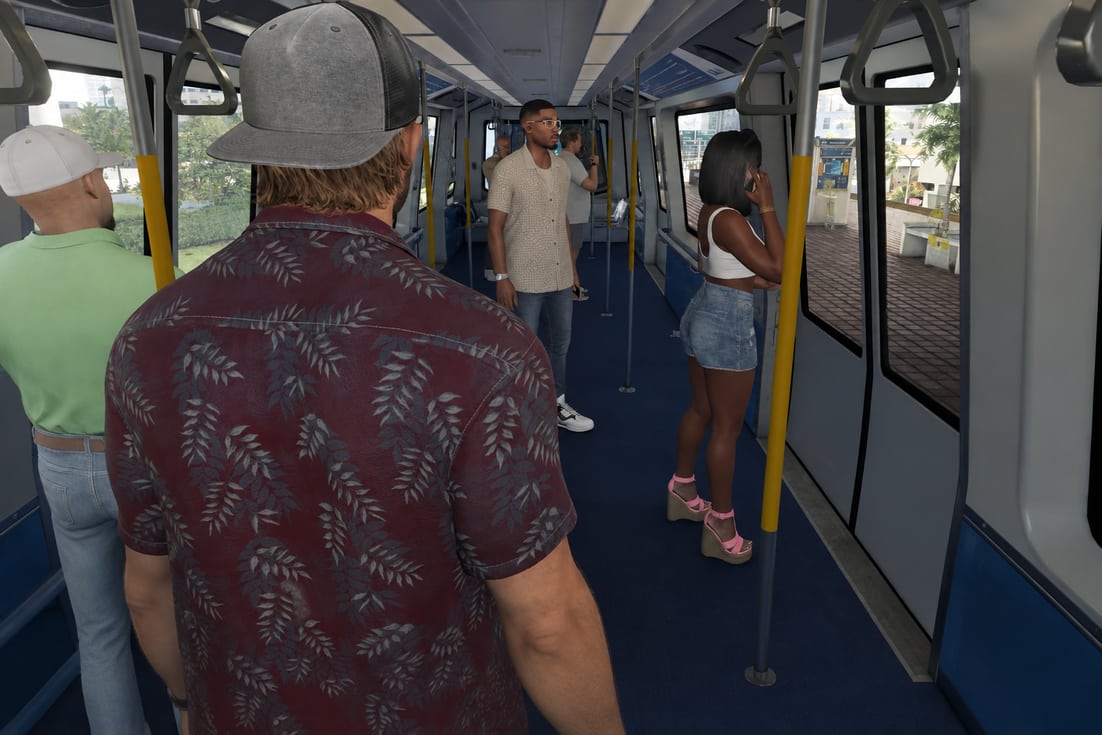
Following an influencer through Vice City starts with a simple distinction: an interesting sequence of actions is not necessarily a repeatable daily routine. A pedestrian might leave a train, walk to a car, and drive across town during one observation. Establishing where that person reliably appears-and whether the journey happens again-requires a separate test.
Before dedicating a session to NPC observation, separate your GTA 6 Money planning from your route notes. List any purchases you already intend to make elsewhere in your playthrough, then give this outing a specific objective: document one character’s movements from the first sighting until you lose visual contact. Record landmarks and changes in activity as you go.
This guide covers launch-period evidence available as of November 25, 2026, following the game’s November 19 release. Confirmed character backgrounds, observed pedestrian behaviour, and repeatable encounter instructions are treated separately. Where an exact location, appearance time, or trigger remains unverified, it is left unspecified.
Who Are Vice City’s NPC Influencers?
Real Dimez: Bae-Luxe and Roxy
Bae-Luxe and Roxy are the clearest named characters connected to Vice City’s influencer culture. Together, they perform as Real Dimez, combining rap music with an aggressive social media presence. Their background includes an early collaboration with local rapper DWNPLY and a subsequent signing to Only Raw Records.
Their identities are established. A complete free-roam timetable is not established by those biographies. Their association with music and online fame should not become an invented schedule of recording sessions, club appearances, or street encounters.
The Music Industry Around Them
Dre’Quan Priest signed Real Dimez as part of his ambitions in the Vice City music scene. His business partner, Boobie Ike, has interests in property, a strip club, and a recording studio. These connections explain the duo’s professional setting, but they are not proof that either performer will appear at a particular business every day.
For tracking purposes, distinguish a character’s established affiliations from a location where you have personally observed that character. The former provides context; the latter gives you a starting point to investigate.
Influencers and Special NPCs: What Is Actually Established?
| Character or encounter | Identity and observed activity | Location information | Timing and interaction limits |
| Bae-Luxe and Roxy | Named performers with an established social media presence | Connected to Vice City’s music industry | Their biographies do not establish a daily free-roam route |
| Unnamed commuting influencer | A player-observed woman travelling by train, walking, and driving while using her phone | Vice City streets, public transport, and parking areas | Exact starting point and repeat schedule remain unverified |
| Unnamed tower climber | An influencer undertaking a dangerous stunt | A radio tower in Leonida | Dialogue interaction is described; a reliable appearance window is not established |
These examples represent different evidence categories: official character information, an individual player’s tracking observation, and a documented special encounter. They should not be combined into a single supposedly universal NPC scheduling system.
Following the Commuting Influencer
The Observed Route
One launch-period tracking observation follows an unnamed woman through several connected activities:
- She leaves a train while using her phone.
- She continues on foot through the surrounding streets.
- She reaches a parking area and enters a car.
- She drives elsewhere while continuing her call.
- She parks and gets out.
The observer subsequently loses her. That leaves the destination, the rest of her day, and the possibility of a return journey unresolved. The sequence supports a connected journey, not a verified home-to-work schedule.
What the Car Does-and Does Not-Tell You
Later, two men arrive and drive away in the vehicle she left behind. Their motive is not established. It would be premature to call this a vehicle-collection job, a theft event, or evidence of a persistent ownership system.
This is also a useful point at which to separate your tracking records. Following the vehicle after its previous occupant leaves is a new observation. Keep it connected to the original encounter in your notes, but do not label the car’s subsequent movements as the influencer’s route.
The Radio-Tower Influencer Encounter
The tower climber provides a more concentrated example of influencer behaviour. She can be encountered hanging from a radio tower, and interaction produces an explanation: she attempted the climb because another influencer, Kelly Explores, had done it. The documented behaviour supports a stunt encounter and a dialogue response. It does not establish Kelly Explores as a separately discoverable character with a known location.
There is no reliable appearance timetable established here. A screenshot showing the encounter at night, for example, would document the conditions of that sighting-not prove that darkness is a spawn requirement.
For your own record, capture:
- The tower’s position on the map.
- Your approach direction.
- The displayed time and weather, where available.
- The character’s position before interaction.
- Any prompt or dialogue that appears.
- What happens after the conversation ends.
These are observation fields, not confirmed encounter requirements.
How Dynamic Behaviour Changes Open-World Exploration
Your Presence Can Interrupt the Activity
Pedestrian observations include a worker becoming irritated when followed and two women reacting together to an interruption before returning to their conversation. These examples show why the player’s approach belongs in the encounter record: the resulting confrontation may differ from what the NPCs would have done undisturbed.
Use separate sessions for separate questions:
- Passive observation: Where does the person go without deliberate interference?
- Interaction testing: What happens when you approach or engage?
- Repeat testing: Does a comparable sequence occur during another visit?
Do not interrupt an interesting conversation merely to test every possible response. You can investigate reactions later; you cannot reconstruct dialogue you missed.
Distinctive Characters Are Not Proof of Universal Schedules
The game’s NPC design includes individual visual identities, personalities, and changing moods. Those features help make encounters feel specific, but they do not establish a complete daily simulation for every pedestrian.
The practical approach is to ask questions that an observation can answer:
- Did this person enter a vehicle?
- Did the conversation continue after an interruption?
- Did the same-looking character appear on another visit?
- Was the route repeated, or did only the starting location match?
Each answer is useful on its own. None needs an invented biography to make it interesting.
How to Discover and Follow Special NPCs
Build the Route From Continuous Evidence
Choose one subject rather than repeatedly switching to whoever looks most unusual. Start recording before approaching, then preserve the sequence through each transition.
- Mark the first confirmed sighting. Use a map position and a visible landmark.
- Record identifying details. Note clothing, hairstyle, accessories, and any vehicle entered.
- Maintain a clear view. Choose a position that lets you observe without repeatedly moving into the character’s path.
- Document transitions. Separate walking, waiting, conversation, transport, and vehicle travel.
- Mark interruptions. Record collisions, confrontations, police activity, or anything else that changes the scene.
- Stop at the last confirmed position. A gap in visibility should remain a gap.
These steps are a testing method, not a hidden unlock sequence.
Keep a Compact Observation Log
| Field | What to record | Why it helps |
| Starting location | Map position and nearby landmark | Gives the next visit a precise starting point |
| Session conditions | Game version, story progress, character, time, weather | Makes differences between visits easier to examine |
| Identity details | Clothing, accessories, voice, vehicle | Helps distinguish a possible repeat sighting |
| Action sequence | Events in the order observed | Preserves the actual route |
| Player interference | Approaches, collisions, threats, interruptions | Separates passive behaviour from reactions |
| Last confirmed position | Exact place where visual contact ended | Prevents assumptions about the missing section |
A statement such as “entered this parking area during this session” is ready to publish as an observation. “Leaves work here every evening” requires evidence of both the workplace and the repeated schedule.
Preparing a Return Visit
Before a dedicated NPC-tracking session, prepare a route log and set a spending limit for any equipment upgrades already confirmed in your game. Include any planned GTA 6 Money for sale expenditure in that preparation budget, keeping the outing’s objective specific: revisit the last recorded sighting, follow the character while they remain visible, and mark each change in activity. Save your notes at the point where contact ends so the next session begins with a clear location to investigate.
On the return visit, change one condition at a time. Try another hour before also changing story progress, playable character, and approach. If someone resembling your subject appears, compare identifying details before treating the encounter as a continuation.
Publish the route you can demonstrate: its starting point, observed actions, interruptions, and endpoint. Leave the unseen journey unwritten.